About to launch: The Demonologia Biblica

So I’ve been involved in this really cool project for the past four or so motion-blurred months: The Demonologia Biblica. A horror anthology from Western Legends Publishing featuring twenty-six stories by twenty-six authors about demons of all kinds doing all sorts of crazy evil things that only demons could do.

I was tasked to write a story featuring a demon with a name beginning with the letter F. After more research I care to admit to on some really geeky strange sites, I found my options were small. Like five options small, three of which were different spellings of the same guy. So I picked Furcas, a knight of hell who is known for teaching and wisdom and whatever else the old books purportedly claim according to those people who study this stuff. His simple folkloric appearance suggests that he is a harbinger of death, but he is also a calm rationale sort of guy. Who knew demons could be pleasant or nice?

My story, “Lies Under Skin,” tells the tale of a seemingly good guy’s encounter with Furcas on the road. Set in the autumnal wooded Hudson River Valley just north of New York City, it gives a subtle nod to one of the area’s most well-known historic writers, Washington Irving. His work was one of my early influences that shaped my taste for fiction.

If any of you are wondering, I might have had something to do with the cover design, that seems to happen a lot. The incredible illustration credit, however, goes to the talented artist James R. Powell.

I will post more here when the book becomes available for purchase, should be by start of February.

Writing for the Reader in Me

I have heard countless times since returning to writing and pursuing my MFA degree “write for yourself.” Coming from the profession I have spent my whole career in, the target audience has always been the first influence on work I have created. So the reader, naturally, is someone I want to write for, never mind the fact that I don’t know many of my readers – if there are even many outside of this blog.

Every writer must have experienced the exhilaration of reading their own work after some time has passed at least once. It’s like a whole other person produced it; a deliberate subconscious separation to a completed story that allows the writer to read it for the first time. It’s a beautiful thing.

Since I don’t have a specified audience for fiction in this embryonic stage, I write about subjects that excite and interest me, maybe scare me, and often stuff I want to learn more about. For example, I have never worked in a circus or government office, so a character I create may be campaigning for a local office or a veteran sideshow performer.

Then there is that old adage “write what you know,” which I do fair amount of. Thing is, some of what I know isn’t necessarily based on first-hand experience, some of it is observational and intuitive. I was never a patient in a psychiatric hospital nor have I committed a murder, but pulling from what I know about these subjects based on research and observation, I can place my head in those spaces and become those flawed characters, in the figurative sense. I know how they think and feel, whether they are rational or irrational, what they base their decisions on. They become real live humans in my brain and on the page. This is probably normal for any writer, perhaps all creative-types; I don’t know, I never asked. Whatever the case, it’s part of my writer’s tool box.

So I write for myself now with the intention that other people of similar mind and dysfunction will appreciate it – maybe even love it! It’s working out so far with another short story this year due to publish soon in an anthology about demons.

Tell me about you. I’m always interested in learning how others think about these topics. Do you write or create for yourself or others? Do you become your characters who deviate widely from your real life?

Happy November!

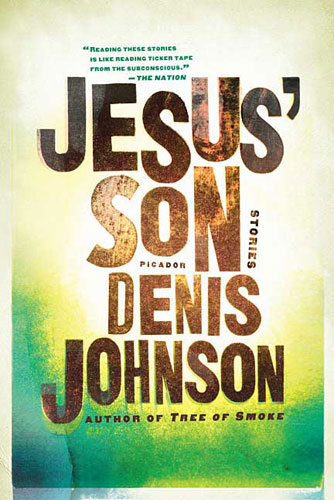
Writing Craft: Jesus’ Son by Denis Johnson

The collection of short stories of Jesus’ Son is something of a paradox. The graceful and poetic language portrays dark and depressing situations occupied by people at their lowest points performing despicable acts. Fluid and sensuous prose carry the narrative forward effortlessly; the time it takes to read the book becomes irrelevant. This was my first time reading Denis Johnson’s work, and not knowing anything about him, I wondered if these vivid stories were pulled from real-life experiences. Either way, I was captivated.

Johnson makes a hospital orderly moving through his day in the story “Emergency” on a drug high sound warm and simple. He seemed to have reached a heightened state of bliss among a bleak and stressful world, while the dire risks of his actions were always prevalent.

Everybody had a different idea about exactly how to approach the problem of removing the knife from Terrence Weber’s brain. But when Georgie came in from prepping the patient—from shaving the patient’s eyebrow and disinfecting the area around the wound, and so on—he seemed to be holding the hunting knife in his left hand. (Loc. 694-696)

Duality is consistently portrayed in an illustrative storytelling motif throughout the stories through an inebriated perception of people and self, and their relationships to the environment. This is a polar extreme to the clichéd my head felt like a balloon and floated from my body and over the green pastures type of hack:

Under Midwestern clouds like great grey brains we left the superhighway with a drifting sensation and entered Kansas City’s rush hour with a sensation of running aground. (Loc. 39-40)

It was a long straight road through dry fields as far as a person could see. You’d think the sky didn’t have any air in it, and the earth was made of paper. Rather than moving, we were just getting smaller and smaller. (Loc. 451-453)

All senses are engaged. Johnson places the reader in the environment through deliberate figurative prose. Landscape description appear frequently, along with the integration of nature, setting the tone of the immediate physical world and then on a higher existential level consistent with the protagonist’s thought process. Consider these examples:

The road we were lost on cut straight through the middle of the world. It was still daytime, but the sun had no more power than an ornament or a sponge. In this light the truck’s hood, which had been bright orange, had turned a deep blue. (Loc. 753-754) 

What word can be uttered about those fields? She stood in the middle of them as on a high mountain, with her red hair pulled out sideways by the wind, around her the green and grey plains pressed down flat, and all the grasses of Iowa whistling one note. (Loc. 567-568)

Descriptions of settings often take on a stream of consciousness quality through the protagonist’s altered perceptions while incorporating actions and people as part of the holistic environment. In this way, Johnson effectively animates common activities like riding on a ferryboat or a subway train:

The day was sunny, unusual for the Northwest Coast. I’m sure we were all feeling blessed on this ferryboat among the humps of very green—in the sunlight almost coolly burning, like phosphorus—islands, and the water of inlets winking in the sincere light of day, under a sky as blue and brainless as the love of God, despite the smell, the slight, dreamy suffocation, of some kind of petroleum-based compound used to seal the deck’s seams. (Loc. 1000-1003)

I sat up front. Right beside me was the little cubicle filled with the driver. You could feel him materializing and dematerializing in there. In the darkness under the universe it didn’t matter that the driver was a blind man. He felt the future with his face. And suddenly the train hushed as if the wind had been kicked out of it, and we came into the evening again.(Loc. 948-951)

People are treated in a similar descriptive manner giving them identifiable realistic traits leaving no room to question their authenticity:

He stood hugging himself and talking down at the earth. The wind lifted and dropped her long red hair. She was about forty, with a bloodless, waterlogged beauty. I guessed Wayne was the storm that had stranded her here. (Loc. 560-561) 

He walked with a bounce, his shoulders looped and his chin scooping forward rhythmically. He didn’t look right or left. I supposed he’d walked this route twelve thousand times. He didn’t sense or feel me following half a block behind him. (Loc. 920-921)

I found the following quote in “Happy Hour” fitting to wrap up my take on Jesus’ Son. By intention or not it seems Johnson was poking fun at the style of his writing and its juxtaposition to the subject matter:

I stayed in the library, crushed breathless by the smoldering power of all those words—many of them unfathomable—until Happy Hour. And then I left. (Loc. 1147-1148) 

Add to your Halloween reading: Unnatural Tales of the Jackalope

It’s the season for all things dark, scary, and fun. If you haven’t already done so, please consider adding our crazy book to your reading list. Help support a bunch of indie writers by purchasing Unnatural Tales of the Jackalope, a short story anthology filled with horror, dark humor, and intrigue, from Western Legends Publishing. You won’t be sorry. It includes my short story “Johnny Versus the Creatures.”

Amazon: http://amzn.com/1477451919

Western Legends: http://westernlegendspublishing.com/ 

Writing Craft: Defining Noir

I love noir. It contains or shares elements of various genres I am drawn to and tend to write in, like disturbed and unusual psychological issues, dystopian themes, hard-boiled character-driven drama, brutal honesty, and gritty realism when it comes to the human condition. I selected several stories from The Best American Noir of the Century, a 731-page short story anthology edited by James Ellroy and Otto Penzler, for this craft-base blog entry.

The anthology is filled with so many great authors and stories I had a hard time deciding where to begin. As the anthology is assembled chronologically by publishing dates, I settled on the earliest works, ranging from 1923 to 1952, to determine what common threads exist between these various stories that classify them as noir. Otto Penzler explains in the Foreword, “noir … is virtually impossible to define, but everyone thinks they know it when they see it. Like many other certainties, it is often wildly inaccurate.” I love this fact about this genre. Its definition seems to reside somewhere in our collective subconscious, an area where the darker side of humanity dwells and occasionally surfaces to disrupt everyday life. Penzler finished the Foreword by saying, “If you find light and hilarity in these pages, I strongly recommend a visit to a mental health professional.” I wouldn’t say I found anything light and hilarious, but I was fascinated by these stories.

Penzler’s statements issued a challenge: what defines noir and makes it so appealing? After reading the stories from Tod Robbins, James M. Cain, Steve Fisher, MacKinlay Kantor, Day Keene, Dorothy B. Hughes, Howard Browne, and Mickey Spillane, the common thread I found was a casual attitude toward death: either the thoughts of killing, driving someone to suicide, or following through with emotionally charged murder, with or without remorse.

In Tod Robbins’s “Spurs,” the short story that was the basis for the controversial 1933 film Freaks, Jacques Courbé, a seemingly harmless circus-performing dwarf, is capable of breaking his wife’s vitality and spirit in exchange for her teasing during their circus wedding and subsequent plans for his wealth. The beautiful, strong, and talented Jeanne Marie only married him for his inherited fortune, he quickly found out. She found him to be a joke as she was determined to keep him at bay and eventually cause his death and take ownership of his inheritance. A year after marriage when the circus was back in town, Jeanne Marie runs to the aid of her old boyfriend the charming bareback rider Simon Lafleur, the “circus Romeo,” to whom she planned to return to after Courbé was dead. Courbé, with the help of his wolf-dog companion whom was also his performance partner and mode of transportation, tracked them down and killed Lafleur.

M. Jaques Courbé cleansed his sword on a kerchief of lace, dismounted, and approached Jeanne Marie. She was still crouching on the floor, her eyes closed, her head held tightly between both hands. The dwarf touched her imperiously on the broad shoulder which had so often carried him.
“Madame,” he said, “we now can return home. You must be more careful hereafter. Ma foi, it is an ungentlemanly business cutting the throats of stable boys!”

In the 1946 story “The Homecoming,” by Dorothy B. Hughes, a strong jealous rage causes the protagonist, Benny, to kill his girlfriend Nan and an old war hero boyfriend who visits her after returning home from Korea. The whole story is focused on Benny’s jealously of Jim, the celebrated war hero and popular kid from high school, as he walks to Nan’s home, climaxing in their unintended deaths. At least he thought the murders were unintentional, despite carrying a gun to the home with the intention to put Jim in his place.

There were lights in most of the houses. You’d think the neighbors would have heard all the noise. Would have come running out to see what was going on. They probably thought it was the radio.

They should have come. If they had come, they’d have stopped him. He didn’t want to kill anyone. He didn’t want even to kill Jim. Just to scare him off. Just give him a scare.

She couldn’t be dead. She couldn’t be, she couldn’t be, she couldn’t be. He sobbed the words into the wind and the dark and the dead brown leaves.

Mickey Spillane’s 1953 story “The Lady Says Die!” portrays a story of a wildly successful Wall Street broker, Duncan, an otherwise good man, who exacts revenge upon an old schoolmate and rival Walter Harrison who took his fiancée away from him through a course of one-upmanship and married her for a short time. He reveals to a detective over drinks his desires and the course of events that led to Walter’s death.

God, how I hated that man! I used to dream of killing him! Do you know, if ever my mind drifted from the work I was doing, I always pictured myself standing over his corpse with a knife in my hand, laughing my head off.

Playing off his rival’s weakness of getting everything he desired, a well-planned series of seemingly causal and innocent events drives Walter to suicide on the anniversary of the date he had stolen Duncan’s fiancée.

Interestingly, one story in this selection had self-awareness for the noir genre, in that human death could not occur as one might suspect. “Gun Crazy,” published in 1940 by MacKinlay Kantor, follows the life of Neslon Tare, who is obsessed with guns from the age of six. He develops amazing dexterity and shooting accuracy, eventually giving way to becoming an outlaw robbing banks and using his trick shooting skills to his advantage to evade capture. The twist, as is revealed by the characters who know him best having grown up with him, is that he cannot hurt a single living soul, he is incapable of shooting people or even rabbits during a hunting trip as a kid. This weakness leads to his eventual capture and imprisonment, and no one, surprisingly, dies.

“You’ll Always Remember Me,” by Steve Fisher, published in 1938, was perhaps the most disturbing of the stories I read. Told in the first person, the 14-year-old protagonist Martin Thorpe reveals his penchant for torturing and killing, both animals and humans. He has a history of being thrown out of schools for causing problems, only accepted into the current military school because his father is wealthy and paid double tuition. He feels remorse for the older brother of his girlfriend about to be executed for his father’s murder, the central theme of the story. However, Duff Ryan, a young detective, senses Thorpe is behind the murder, using a gruesome tactic to prove his suspicions.

Duff walks Thorpe to a chapel on the school campus discussing his violent past school records, beginning the conversation that they had a job to do, to “kill a kitten,” one that had been severely injured by a car and Duff kept alive with an injection to reduce pain for this scene.

I could see the funny twist of his smile there in the moonlight. His face looked pale and somehow far away. He looked at the cat and petted it some more. I was still shaking. Scared, I guess.

He said, “Too bad we have to kill you, kitten, but it’s better than that pain.”

Then, all at once I thought he had gone mad. He swung the cat around and began batting its head against the pillar in the chapel. I could see the whole thing clearly in the moonlight, his arm swinging back and forth, the cat’s head being battered off, the bright crimson blood spurting all over.

He kept on doing it and my temples began to pound. My heart went like wildfire. I wanted to reach over and help him. I wanted to take that little cat and squeeze the living guts out of it. I wanted to help him smash its brains all over the chapel. I felt dizzy. Everything was going around. I felt myself reaching for the cat. 

With the awareness that Duff was testing him, he manages to restrain himself and not partake in the cat’s killing. Soon after, Thorpe is able to act on his desire to kill, when he pushes Pushton, a younger kid who plays the bugle each morning, out of a dormitory window to his death. Thorpe is eventually caught for the murder of his girlfriend’s father and takes pride in the fact that he cannot go to prison or be executed because of his young age, reform school was his only punishment. To his frustration however, no one believes he was behind the death of Pushton as much as he brags about it, as it was attributed to an accident.

The blatant unapologetic honesty of human desire and controlling the fates of other people’s lives is central to all of these stories. Filled with emotional and psychological complexities based around human relationships and perceptions, noir contains an incredible gamut of storylines and settings, each story as compelling, even more so, than the last. And the beauty of it all is that these stories are timeless, as human nature has not changed in the past century, if not millennium, and probably never will.