Sneak peek: cover for Vol. 2 of Tres Librorum Prohibitorum – The Bestiarum Vocabulum

I’m excited to share this new anthology project. Publishes soon!

Reposted from the original blog found here: Sneak peek: cover for Vol. 2 of Tres Librorum Prohibitorum – The Bestiarum Vocabulum.

The Bestiarum Vocabulum - cover spread

Western Legends is excited to share with you the cover of our new anthology The Bestiarum Vocabulum, edited by Dean M. Drinkel. This is the second installment of the Tres Librorum Prohibitorum series. Special thanks to artist James Powell for the killer illustration on the front cover!

It wouldn’t be a Drinkel anthology without a plethora of authors – check out the roster:

Jason D. Brawn
Adrian Chamberlin
Lily Childs
Raven Dane
Nerine Dorman
Christine Dougherty
Dean M. Drinkel
Tim Dry
Jan Edwards
D.T. Griffith
Lisa Jenkins
Emile-Louis Tomas Jouvet
Rakie Keig
Amelia Mangan
Peter Mark May
Christine Morgan
Joe Mynhardt
Sandra Norval
John Palisano
Martin Roberts
Andy Taylor
Tej Turner
Robert Walker
Mark West
Barbie Wilde
D.M. Youngquist

About to launch: The Demonologia Biblica

So I’ve been involved in this really cool project for the past four or so motion-blurred months: The Demonologia Biblica. A horror anthology from Western Legends Publishing featuring twenty-six stories by twenty-six authors about demons of all kinds doing all sorts of crazy evil things that only demons could do.

I was tasked to write a story featuring a demon with a name beginning with the letter F. After more research I care to admit to on some really geeky strange sites, I found my options were small. Like five options small, three of which were different spellings of the same guy. So I picked Furcas, a knight of hell who is known for teaching and wisdom and whatever else the old books purportedly claim according to those people who study this stuff. His simple folkloric appearance suggests that he is a harbinger of death, but he is also a calm rationale sort of guy. Who knew demons could be pleasant or nice?

My story, “Lies Under Skin,” tells the tale of a seemingly good guy’s encounter with Furcas on the road. Set in the autumnal wooded Hudson River Valley just north of New York City, it gives a subtle nod to one of the area’s most well-known historic writers, Washington Irving. His work was one of my early influences that shaped my taste for fiction.

If any of you are wondering, I might have had something to do with the cover design, that seems to happen a lot. The incredible illustration credit, however, goes to the talented artist James R. Powell.

I will post more here when the book becomes available for purchase, should be by start of February.

Writing Craft: The Delicate Prey by Paul Bowles

Dark subjects driven by the dark psychology of the characters rooted in a common thread of loneliness. The short stories of The Delicate Prey are best described as “messed up” as someone noted in a short review I spotted on Good Reads. Artfully written bringing early twentieth century Latin America to life, contrasting the natural beauty of the land with the less-than-desirable living conditions of the locals.

An element of racism exists among those of Spanish descent toward the native people – known simply as Indians – adding to the tensions and demeanor of the characters, providing a sense of entitlement for some to act upon their ill intentions. In the first story, “At Paso Rojo,” an upper-class woman, Chalía, and her sister, visit their brother’s ranch after their mother has died. Chalía makes a game of emotionally manipulating and injuring a young Indian man who works for her brother. The specific root of behavior is not apparent beyond her open discrimination toward the Indians, though we learn of lying and deceptive behaviors through the story, and her desire to control others. The following passage paints a vivid portrait of Chalía’s diabolical nature.

Something dark lying in the road ahead of her made her stop walking. It did not move….as she drew near, she knew it was Roberto. She touched his arm with her foot. He did not respond. She leaned over and put her hand on his chest. He was breathing deeply, and the smell of liquor was almost overpowering. She straightened and kicked him lightly in the head. There was a tiny groan from far within. This also, she said to herself, would have to be done quickly. She felt wonderfully light and powerful as she slowly maneuvered his body with her feet to the right-hand side of the road. There was a small cliff there, about twenty feet high. When she got him to the edge, she waited a while, looking at his features in the moonlight. His mouth was open a little, and the white teeth peeked out from behind the lips. She smoothed his forehead a few times and with a gentle push rolled him over the edge. He fell very heavily, making a strange animal sound as he hit. (P. 18)

 “The Scorpion” was probably one of the strangest stories I read, and the most thought provoking. Two sons had left their elderly mother to live in a cave they dug out of clay for an undetermined length of time. She was left to survive with a bare minimum of supplies, her dreams, and her memories. Surrounded by scorpions in the walls and constant dripping water, she adapts to her solitude.

There were many things about this life that the old woman liked. She was no longer obliged to argue and fight with her sons to make them carry wood to the charcoal oven. She was free to move about at night and look for food. She could eat everything she found without having to share it. And she owed no one any debt of thanks for the things she had in her life. (P. 103)

Finally, one of her sons arrives to retrieve her, he seems surprised that either she is still there or alive; she refuses to leave at first. We don’t know why he is there for her, but it is clear their relationship is not good as she is not even sure of his identity.

One dark day he looked up to see one of her sons standing in the doorway. She could not remember which one it was, but she thought it was the one who had ridden the horse down the dry river bed and nearly been killed. She looked at his hand to see if it was out of shape. It was not that son. (P. 103)

We never learn the names of the old woman nor her son, not even the anonymous old man who sits outside the cave occasionally without any interaction. Her closest interaction with another person is built on isolation:

One old man used to come from the village on his way down to the valley, and sit on a rock just distant enough from the cave for her to recognize him. She knew he was aware of her presence in the cave there, and although she probably did not know this, she disliked him for not giving some sign that he knew she was there. (P. 103)

We can only surmise the reason the old woman was sent to live in a cave by her two resentful sons far outside of town was that it was intended to be her tomb. What we do learn is implied through actions and the bitter dialogue; the specifics about their estrangement are clear. It’s best summed up in this exchange at the close of the story as the son leads his mother out of the cave and the surprised old man sitting nearby says “good-bye”:

“Who is that?” said her son.
“I don’t know.”
Her son looked back at her darkly.
“You’re lying,” he said. (P. 106)

Interestingly, the story “The Fourth Day Out from Santa Cruz” paints a dark portrait of loneliness and despondency not unlike the other stories, but with a happy ending, as happy as one could expect in the circumstances. A young man named Ramón signed on to the crew of a ship, working in the scullery.

Except for the orders they gave him in the kitchen, the sailors behaved as if he did not exist. They covered his bunk with dirty clothes, and lay on it, smoking, at night when he wanted to sleep. They failed to include him in any conversation, and so far no one had even made an allusion, however deprecatory, to his existence. (P. 106-107)

During a stopover in a port town, Ramón searches for the crew after he has finished cleaning the kitchen, hours after the crew had left the ship. He finds a group of them in a café. The following scene captures the anguish and anger Ramón confronts as it continues to build to a climax:

Ramón turned around and sat down suddenly at a small table. The waiter came an served him, but he scarcely noticed what he was drinking. He was watching the table with the six men from his ship. Like one fascinated, he let his eyes follow each gesture: the filling of the little glasses, the tossing down the liquor, the back of the hand wiping the mouth. And he listened to their words punctuated by loud laughter. Resentment began to swell in him; he felt that if he sat still any longer he would explode. Pushing back his chair, he jumped up and strode dramatically out into the street. No one noticed his exit. (P. 108)

As Ramón continues to find ways draw the sailors’ attention to no avail, he sees an opportunity during their fourth day out at sea. A tired bird far from land is desperate to land on the ship’s deck, but the gawking crew scares it from doing so. As they place bets on the bird’s fate, Ramón brings out the ship’s mascot, a large cat, and trains the cat’s focus on the bird to attempt to catch it. The sailors are impressed.

In a situation that appeared to be leading to some type of violent act of Ramón’s doing was cleverly displayed by the cat attempting to catch the bird without success. Yet, Ramón is awarded with the acceptance from his crewmates he craved.

At noonday meal they talked about it. After some argument the bets were paid. One of the oilers went to his cabin and brought out a bottle of cognac and a set of little glasses which he put in front of him and filled, one after the other.
“Have some?” he said to Ramón.

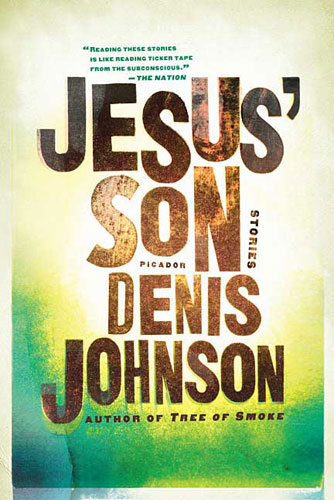
Writing Craft: Jesus’ Son by Denis Johnson

The collection of short stories of Jesus’ Son is something of a paradox. The graceful and poetic language portrays dark and depressing situations occupied by people at their lowest points performing despicable acts. Fluid and sensuous prose carry the narrative forward effortlessly; the time it takes to read the book becomes irrelevant. This was my first time reading Denis Johnson’s work, and not knowing anything about him, I wondered if these vivid stories were pulled from real-life experiences. Either way, I was captivated.

Johnson makes a hospital orderly moving through his day in the story “Emergency” on a drug high sound warm and simple. He seemed to have reached a heightened state of bliss among a bleak and stressful world, while the dire risks of his actions were always prevalent.

Everybody had a different idea about exactly how to approach the problem of removing the knife from Terrence Weber’s brain. But when Georgie came in from prepping the patient—from shaving the patient’s eyebrow and disinfecting the area around the wound, and so on—he seemed to be holding the hunting knife in his left hand. (Loc. 694-696)

Duality is consistently portrayed in an illustrative storytelling motif throughout the stories through an inebriated perception of people and self, and their relationships to the environment. This is a polar extreme to the clichéd my head felt like a balloon and floated from my body and over the green pastures type of hack:

Under Midwestern clouds like great grey brains we left the superhighway with a drifting sensation and entered Kansas City’s rush hour with a sensation of running aground. (Loc. 39-40)

It was a long straight road through dry fields as far as a person could see. You’d think the sky didn’t have any air in it, and the earth was made of paper. Rather than moving, we were just getting smaller and smaller. (Loc. 451-453)

All senses are engaged. Johnson places the reader in the environment through deliberate figurative prose. Landscape description appear frequently, along with the integration of nature, setting the tone of the immediate physical world and then on a higher existential level consistent with the protagonist’s thought process. Consider these examples:

The road we were lost on cut straight through the middle of the world. It was still daytime, but the sun had no more power than an ornament or a sponge. In this light the truck’s hood, which had been bright orange, had turned a deep blue. (Loc. 753-754) 

What word can be uttered about those fields? She stood in the middle of them as on a high mountain, with her red hair pulled out sideways by the wind, around her the green and grey plains pressed down flat, and all the grasses of Iowa whistling one note. (Loc. 567-568)

Descriptions of settings often take on a stream of consciousness quality through the protagonist’s altered perceptions while incorporating actions and people as part of the holistic environment. In this way, Johnson effectively animates common activities like riding on a ferryboat or a subway train:

The day was sunny, unusual for the Northwest Coast. I’m sure we were all feeling blessed on this ferryboat among the humps of very green—in the sunlight almost coolly burning, like phosphorus—islands, and the water of inlets winking in the sincere light of day, under a sky as blue and brainless as the love of God, despite the smell, the slight, dreamy suffocation, of some kind of petroleum-based compound used to seal the deck’s seams. (Loc. 1000-1003)

I sat up front. Right beside me was the little cubicle filled with the driver. You could feel him materializing and dematerializing in there. In the darkness under the universe it didn’t matter that the driver was a blind man. He felt the future with his face. And suddenly the train hushed as if the wind had been kicked out of it, and we came into the evening again.(Loc. 948-951)

People are treated in a similar descriptive manner giving them identifiable realistic traits leaving no room to question their authenticity:

He stood hugging himself and talking down at the earth. The wind lifted and dropped her long red hair. She was about forty, with a bloodless, waterlogged beauty. I guessed Wayne was the storm that had stranded her here. (Loc. 560-561) 

He walked with a bounce, his shoulders looped and his chin scooping forward rhythmically. He didn’t look right or left. I supposed he’d walked this route twelve thousand times. He didn’t sense or feel me following half a block behind him. (Loc. 920-921)

I found the following quote in “Happy Hour” fitting to wrap up my take on Jesus’ Son. By intention or not it seems Johnson was poking fun at the style of his writing and its juxtaposition to the subject matter:

I stayed in the library, crushed breathless by the smoldering power of all those words—many of them unfathomable—until Happy Hour. And then I left. (Loc. 1147-1148) 

Add to your Halloween reading: Unnatural Tales of the Jackalope

It’s the season for all things dark, scary, and fun. If you haven’t already done so, please consider adding our crazy book to your reading list. Help support a bunch of indie writers by purchasing Unnatural Tales of the Jackalope, a short story anthology filled with horror, dark humor, and intrigue, from Western Legends Publishing. You won’t be sorry. It includes my short story “Johnny Versus the Creatures.”

Amazon: http://amzn.com/1477451919

Western Legends: http://westernlegendspublishing.com/