Finding Closure

Sandy’s leftover clouds in Massachusetts
Find me on Instagram: dtgriffith

I finally found a way to close a story that has been alive and with me – in the developmental sense – for fifteen months. It’s the longest, most complex story I have ever written, still qualifying as a short story or novella, depending on who’s rules you follow. It really makes no difference to me. The challenge was whether I wanted the protagonist to redeem herself, to live to see another story, despite her horrific actions and questionable behavior. My final answer: a resounding yes.

It’s amazing how vested I became with the character. I’ve heard of authors who take on extraordinary experiences to get inside a character’s head and comprehend their wisdom. I wonder how often writers find themselves questioning the fate of their characters, do they decide to kill their darlings or give them a second chance?

Series obviously allow a main character to live on, otherwise they wouldn’t work, unless there is something out there I don’t know about. Whatever the case, an entire industry of fiction based franchises exists for this reason alone. I’m not necessarily out to accomplish this, however. But I wouldn’t complain if I found myself there one day. Perhaps I am nascent, having been out of the writing loop for several years to focus on my initial visual arts career and start a family. It doesn’t matter, in the grand scheme, as my rugged individualist nature leads me down the path of nonconformity.

So back to this idea of finding closure. It’s not true closure, per se, it’s a turning point. An opportunity to end one chapter to begin the next. I know, not a profound thought, but authentic nonetheless. Closure of a storyline is more important for the audience, no one likes to be strung along and left hanging as the story ends. I hate when this happens to me as a reader or movie watcher. Closure is an obligation to the reader, so the author’s career may live to see another day.

Here I am, running in circles with these recent blog posts, finding all roads lead to Rome, so to speak. Finding closure is in line with my self-exploration in fighting creative fear and writing for the reader. So, why I am writing this? Besides the catharsis it provides to get it all out there, I’m thinking maybe others will realize they are not along in their struggles as they endeavor to be masters of the craft. If nothing else, it’s a small contribution I am happy to offer.

How many clichés can you count in this post? It surprises me how easy they are to write when not thinking about it, but that’s for another blog entry another day.

Writing Craft: Love and Hydrogen by Jim Shepard

Jim Shepard’s collection of stories is a unique mix of heavily flawed characters, dysfunctional families, early twentieth century military and engineering feats, classic horror movies, and dark humor. His stories take unconventional approaches to a variety of taboo and uncomfortable subjects, of which I am focusing on the stories portraying the protagonists or cast of characters near death.

A self-deprecating husband tells the first story in the collection, “The Gun Lobby,” in the present tense as his gun-crazy wife holds him hostage during a standoff with law enforcement. The scene is a catalyst for the protagonist to reflect on his marriage and his personal failures with a strange sense of calm and humor, in which they can watch themselves on the local news shortly before meeting their probable demise:

“Here” is Waterbury, Connecticut, which is right now the main show in terms of the cutaway news, because of the standoff. You can see Stephanie or me, the Hostage, at the windows every so often on TV. We watch ourselves. (Kindle Loc. 89-91)

I’ve been a problem baby, a lousy son, a distant brother, an off-putting neighbor, a piss-poor student, a worrisome seatmate, an unreliable employee, a bewildering lover, a frustrating confidant, and a crappy husband. Among the things I do pretty well at this point I’d have to list darts, reclosing Stay-Fresh boxes, and staying out of the way.   (Kindle Loc. 147-150)

As the story reaches its climax, the seriousness of the situation is down played with lighthearted metaphors and observational wisdom:

I have a hold of Stephanie’s ankle. For the longest time I’m not hurt. Her rate of fire is spectacular. The ordnance coming back at us sets everything in the kitchen into electric life. Our overhead fixture’s doing a tarantella. (Kindle Loc. 228-229)

There are events in which every second can be taken out of line, examined this way and that, and then allowed to move along. This is one of them. (Kindle Loc. 230-231)

The title story “Love and Hydrogen,” set in the Hindenburg over the last few days of its final voyage told in the present tense, follows the homosexual relationship between two crew members: Meinert, a German war vet who took pride in his bombing raids on England and France, a Gnüss, who is much younger, jealous, and infatuated with Meinert. The tension displayed from Gnüss’s perspective of their relationship is filled with fond memories of their love and Meinert’s war stories. As the drama plays out the dark humor creeps in at unexpected moments juxtaposed against the reader’s relentless knowledge that the Hindenburg would soon meet its fate:

Egk is a fat little man with boils. Meinert considers him to have been well named. (Kindle Loc. 277-278)

[Gnüss] goes below and stops by the crew’s quarters. No luck. He listens in on a discussion of suitable first names for children conceived aloft in a zeppelin. The consensus favors Shelium, if a girl. (Kindle Loc. 411-413)

Ultimately, Gnüss’s despondency and jealousy brings down the zeppelin and everyone aboard:

Inside the hangarlike hull, they can feel the gravitational forces as Captain Pruss brings the ship up to the docking mast in a tight turn. The sharpness of the turn overstresses the after-hull structure, and the bracing wire bolt that Gnüss overtightened snaps like a rifle shot. The recoiling wire slashes open the gas cell opposite. Seven or eight feet above Gnüss’s alarmed head, the escaping hydrogen encounters the prevailing St. Elmo’s fire playing atop the ship. (Kindle Loc. 475-478)

The fireball explodes outward and upward, annihilating Gnüss at its center. More than 100 feet below on the axial catwalk, as the blinding light envelops everything below it, Meinert knows that whatever time has come is theirs, and won’t be like anything else. (Kindle Loc. 479-481)

The final story of the collection, “Climb Aboard the Mighty Flea,” follows a small squadron of German soldiers during World War II who stopped caring about the war. Their job was to fly the “Messerschmitt 163 [the Komet], the first manned rocket-powered aircraft, the first aircraft in the world to exceed a thousand kilometers an hour in level flight, and in statistical terms the most dangerous aircraft ever built in a series.” (Kindle Loc. 4593-4595) They were intended as a line of defense to take down Allied bombers over Germany, albeit with poor effectiveness. Their lives were built around the high risks in piloting these rockets during testing and training exercises:

So? we said to ourselves. Everyone knew that learning to fly meant little more than learning to land.

But pilots are taught to land by flying alongside instructors. There was no room for two in these things. So we’d have to be told, rather than shown.

“Does the landing,” Ziegler asked in a classroom session, “have to be perfect?”

“No,” Wörndl shrugged. “You could die, instead.” (Kindle Loc. 4663-4667)

 As the story goes, a number of pilots die horrible deaths or experience grave injuries. Yet, it carries on in Shepard’s light-hearted and sometimes grotesque manner:

The cockpit was filled with a black-and-red-and-yellow soup. The yellow looked like chicken fat. The fuel cells had shattered and the fuel had poured into the cockpit. Those who understood explained it to those who still didn’t: Glogner had been dissolved alive. (Kindle Loc. 4724-4726)

The next Komet exploded on the flight line. When we reached the spot, there was only a blackened and steaming stain. Medical personnel found a bone fragment, and brought it in on a stretcher. (Kindle Loc. 4733-4734)

Rösle’s Komet flipped on landing just before the perimeter. It didn’t explode and he was pulled from it just conscious, but pints of the fuel had run over his back while he hung there, and when they tore off the flight suit, the skin underneath was a jelly. He was on enough painkillers to last until April. (Kindle Loc. 4827-4829)

The collective psychology of the squadron enters a mix of depression and isolation. They adopt a gallows humor to cope with the near-death risks of their job while celebrating their love for the Komets:

My turn came next. “Come come come, Baby Bird,” Uhlhorn said as I held up my straw. “Your one-six-three-B is steaming and ready to blow. We need to put you in it or it will blow up for no reason.” (Kindle Loc. 4735-4736)

We are all insomniacs. We are, as a group, a picturesque compendium of physical tics. (Kindle Loc. 4779)

WHEN I WAKE there’s an impromptu celebration and meeting around my bunk. It transpires that Wörndl’s Komet caught fire right above the field. He had to bail out forty meters from the treetops and his parachute caught the upper branches of a big pine, insuring he only cracked his ankle. He tells everyone that it was like jumping off a church steeple with an umbrella. (Kindle Loc. 4823-4826)

In conclusion, I could discuss this collection for endless hours, as the stories are rich in vivid content and unusual circumstances. I highly recommend Love and Hydrogen to anyone who enjoys the art of short fiction.

Writing for the Reader in Me

I have heard countless times since returning to writing and pursuing my MFA degree “write for yourself.” Coming from the profession I have spent my whole career in, the target audience has always been the first influence on work I have created. So the reader, naturally, is someone I want to write for, never mind the fact that I don’t know many of my readers – if there are even many outside of this blog.

Every writer must have experienced the exhilaration of reading their own work after some time has passed at least once. It’s like a whole other person produced it; a deliberate subconscious separation to a completed story that allows the writer to read it for the first time. It’s a beautiful thing.

Since I don’t have a specified audience for fiction in this embryonic stage, I write about subjects that excite and interest me, maybe scare me, and often stuff I want to learn more about. For example, I have never worked in a circus or government office, so a character I create may be campaigning for a local office or a veteran sideshow performer.

Then there is that old adage “write what you know,” which I do fair amount of. Thing is, some of what I know isn’t necessarily based on first-hand experience, some of it is observational and intuitive. I was never a patient in a psychiatric hospital nor have I committed a murder, but pulling from what I know about these subjects based on research and observation, I can place my head in those spaces and become those flawed characters, in the figurative sense. I know how they think and feel, whether they are rational or irrational, what they base their decisions on. They become real live humans in my brain and on the page. This is probably normal for any writer, perhaps all creative-types; I don’t know, I never asked. Whatever the case, it’s part of my writer’s tool box.

So I write for myself now with the intention that other people of similar mind and dysfunction will appreciate it – maybe even love it! It’s working out so far with another short story this year due to publish soon in an anthology about demons.

Tell me about you. I’m always interested in learning how others think about these topics. Do you write or create for yourself or others? Do you become your characters who deviate widely from your real life?

Happy November!

Fighting Creative Fear

In my latest writing ventures, I find myself once again staring down the dead eyes of fear. The polar opposite to creativity when the so-called writer’s block has taken hold. Thing is, it’s not a block, it’s confronting the wide-open unknown. In one aspect, I am playing god with my characters in a fiction piece whose outcomes have been conceived and reconceived several times over while pondering the structure of a nonfiction book. I have confronted fear on numerous occasions, never submitting to it. Yet, I still find myself here.

Some days I wish my life were as simple as coming home from work, turning on the TV, and eventually going to bed. That simplicity would make me crazy. It’s an escapist thought to avoid this inevitable confrontation. Better thought: escape to Disney World for a day or a year. It’s easy to avoid fear, to let it win. And then what – spend a lifetime burying my head and cowering in the corner?

So, what’s the point of me writing this. I’m sure you’re wondering that as I am. To confront fear in the creative sense. To realize, to affirm, to share the lesson that creativity dies when fear fills the void. Embrace the unknown; mold it in your mind’s image. Create your world before bloodless zombies scare it out of you. Hold a pep rally, fall asleep at the bar, enter altered states of dementia; whatever motivates you. Just try not to harm anyone in the process. My point is – as I beat it into my own subconscious – you need to maintain control, kill some zombies, and spend a well-deserved week at Disney because those monstrous writing projects are complete and on their way to publication. Until then, never give in. Let creativity reign.

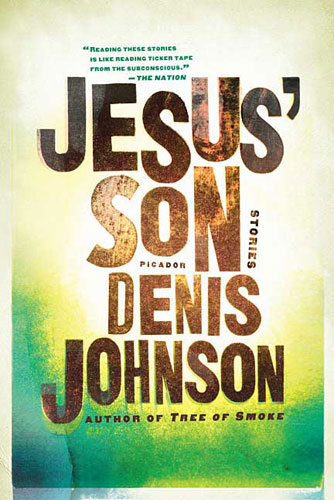
Writing Craft: Jesus’ Son by Denis Johnson

The collection of short stories of Jesus’ Son is something of a paradox. The graceful and poetic language portrays dark and depressing situations occupied by people at their lowest points performing despicable acts. Fluid and sensuous prose carry the narrative forward effortlessly; the time it takes to read the book becomes irrelevant. This was my first time reading Denis Johnson’s work, and not knowing anything about him, I wondered if these vivid stories were pulled from real-life experiences. Either way, I was captivated.

Johnson makes a hospital orderly moving through his day in the story “Emergency” on a drug high sound warm and simple. He seemed to have reached a heightened state of bliss among a bleak and stressful world, while the dire risks of his actions were always prevalent.

Everybody had a different idea about exactly how to approach the problem of removing the knife from Terrence Weber’s brain. But when Georgie came in from prepping the patient—from shaving the patient’s eyebrow and disinfecting the area around the wound, and so on—he seemed to be holding the hunting knife in his left hand. (Loc. 694-696)

Duality is consistently portrayed in an illustrative storytelling motif throughout the stories through an inebriated perception of people and self, and their relationships to the environment. This is a polar extreme to the clichéd my head felt like a balloon and floated from my body and over the green pastures type of hack:

Under Midwestern clouds like great grey brains we left the superhighway with a drifting sensation and entered Kansas City’s rush hour with a sensation of running aground. (Loc. 39-40)

It was a long straight road through dry fields as far as a person could see. You’d think the sky didn’t have any air in it, and the earth was made of paper. Rather than moving, we were just getting smaller and smaller. (Loc. 451-453)

All senses are engaged. Johnson places the reader in the environment through deliberate figurative prose. Landscape description appear frequently, along with the integration of nature, setting the tone of the immediate physical world and then on a higher existential level consistent with the protagonist’s thought process. Consider these examples:

The road we were lost on cut straight through the middle of the world. It was still daytime, but the sun had no more power than an ornament or a sponge. In this light the truck’s hood, which had been bright orange, had turned a deep blue. (Loc. 753-754) 

What word can be uttered about those fields? She stood in the middle of them as on a high mountain, with her red hair pulled out sideways by the wind, around her the green and grey plains pressed down flat, and all the grasses of Iowa whistling one note. (Loc. 567-568)

Descriptions of settings often take on a stream of consciousness quality through the protagonist’s altered perceptions while incorporating actions and people as part of the holistic environment. In this way, Johnson effectively animates common activities like riding on a ferryboat or a subway train:

The day was sunny, unusual for the Northwest Coast. I’m sure we were all feeling blessed on this ferryboat among the humps of very green—in the sunlight almost coolly burning, like phosphorus—islands, and the water of inlets winking in the sincere light of day, under a sky as blue and brainless as the love of God, despite the smell, the slight, dreamy suffocation, of some kind of petroleum-based compound used to seal the deck’s seams. (Loc. 1000-1003)

I sat up front. Right beside me was the little cubicle filled with the driver. You could feel him materializing and dematerializing in there. In the darkness under the universe it didn’t matter that the driver was a blind man. He felt the future with his face. And suddenly the train hushed as if the wind had been kicked out of it, and we came into the evening again.(Loc. 948-951)

People are treated in a similar descriptive manner giving them identifiable realistic traits leaving no room to question their authenticity:

He stood hugging himself and talking down at the earth. The wind lifted and dropped her long red hair. She was about forty, with a bloodless, waterlogged beauty. I guessed Wayne was the storm that had stranded her here. (Loc. 560-561) 

He walked with a bounce, his shoulders looped and his chin scooping forward rhythmically. He didn’t look right or left. I supposed he’d walked this route twelve thousand times. He didn’t sense or feel me following half a block behind him. (Loc. 920-921)

I found the following quote in “Happy Hour” fitting to wrap up my take on Jesus’ Son. By intention or not it seems Johnson was poking fun at the style of his writing and its juxtaposition to the subject matter:

I stayed in the library, crushed breathless by the smoldering power of all those words—many of them unfathomable—until Happy Hour. And then I left. (Loc. 1147-1148)