Motivation is my vicious circle

Motivation has been on my mind lately, due in large part to reading Daniel Pink’s Drive, which I recommend everyone to check out. So I’m looking at how it relates to what I do as a writer and how I can write about its existence in a professional setting. And I continue to wrestle with it.

Then I had the brainstorm when fear motivates us. What could possibly be good about a negative motivator? Are there exceptions to the rules of intrinsic and extrinsic motivation? As I felt the need for my bones to rip out of my skin in pondering this, an epiphany struck me – I’m fighting through motivational issues right now as I type these words. Feeling unmotivated to write about motivation. Not good.

Returning to my earlier question about fear motivating us in a positive way – sure, in that no one wants to be called a failure or deadbeat. In business, I see fear a lot, and I see it driving people to do things – albeit strange, often counterproductive things – but it is a powerful force that must be recognized.

For example, I’ve witnessed a manager’s decision to end a key communication project – one that was nearing completion – only to replace it with another mundane safe-yet-proven-ineffective initiative. Why? The manager voiced second thoughts that a higher-up wouldn’t respect the original initiative. And fear that too much information wasn’t good because it could cause employees to be hired out of the company should info somehow leak to the competition. A frustrating scenario to say the least. And I’m not talking about trade secrets leaking, just comprehensive information for the betterment of the employee body and improve efficiency of business as a whole.

I don’t mean to write in the abstract, but various non-disclosure agreements I’ve signed over the years put me in an awkward spot.

The reality is the employee body wants honest, transparent communication. They want access to information so they know who does what in which department at what location, especially in a global organization. Access to useful information eases work processes and reduces frustrations, which in turn increases efficiencies and productivity. Not a hard concept to fathom, unless fear of trying something new and different is a restraint. This is a common theme with vertically structured organizations that have been around a long time and are finding it difficult to survive in the current business climate of horizontal matrices and the flexibility of the up-and-coming Results Only Work Environments.

So, that is just one example of many that I can somewhat write about without risking litigation. Maybe I’m exaggerating a little, but far less than if I was to start a sentence with “let’s be honest….” My point – this is a topic I must explore in further detail on this blog within the realm of creativity vs. fear.

That preceding statement is the motivation I needed to realize to so I could write these words. It’s all a large infinity loop of jagged lines and hooks.

If you’ve learned something – anything – from this post, please tell me about it. It’s the details between the lines readers pick out that seem to resonate most, and I learn a lot from that in return.

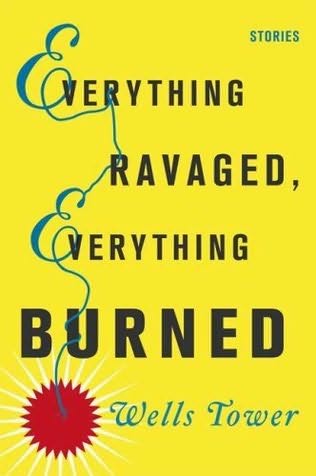
Writing Craft: Everything Ravaged, Everything Burned by Wells Tower

I found myself reading a kindred spirit in the writing style of Wells Tower. Tower takes a comprehensive approach to character development and story complexity, with the attitude of a fellow Gen Xer. Well-written subject matter carried a dark subtext, but not usually of some harrowing violence or a macabre scene – though the unusual title story “Everything Ravaged, Everything Burned” certainly filled that role, following a violent story of Viking invaders with hints of fantasy and speaking in current day vulgarity. These were stories about every day real people living real lives in the face of adversity and challenging interpersonal relationships.

The stories all fit the slice of life style I studied in college twenty-plus years ago, though much more developed and filled out. The darkest element was what was not written; the ambiguity. The stories ended with little-to-no closure after setting up tense scenes, elaborate intertwining storylines, and characters the reader can easily become vested in. For example, in the story “On the Show” we are left wondering if the perpetrator of an awful child-molestation act at a carnival is caught during the on-going police investigation. While the story follows the momentary lives of several characters at the carnival, his identity is casually revealed near the end as he thinks about his wife and daughter following a cattle competition he had just hosted:

But he doesn’t care for the pointless velocity of the carnival amusements. Looking out at the whirling skyline of the fair, he can’t help thinking about all the earth you could move, all the beef you could haul with so much fuel and good steal. He thinks, too, of last night, of the boy in the Honeypot, and feels a pleasant ache, like being rasped on the back of the sternum with a jeweler’s file. There’s a want in him to take a stroll around, but he pushes it down. (Nook Ed., p. 148)

With exception to the title story, I found myself struggling to accept the stories’ endings; I wasn’t ready to finish when they did. The lush prose and witty language made for compelling page turning, but the endings left too much unresolved.

I did something I don’t normally do when I write a book response or review: I read some online reviews by other readers to see how they responded as I work my way through my own takeaways. Everything Ravaged, Everything Burned was loved by many readers though a handful disliked the lack of closure displaying the same feelings I had when I finally put the book down. Going back to my original point, it’s what wasn’t written that caught my attention. It was intentional to create discomfort, depicting the uncertainty of the real world. Not everything has a clean ending, or an ending at all, as we move through time and space interacting with each other.

As far as writing craft goes, it’s difficult for me to find specific focus on what I may have gained from Everything Ravaged, Everything Burned as I did from other recent books this year. His writing style shares many craft elements to my own. I will say this, though, it gave me a new respect for taking chances, particularly leaving stories intentionally open-ended. And it has spurred a new thought-process worth considering in forcing the reader to make connections and draw conclusions. I’m sure a few readers were put off for this reason, but I embraced it the trust and confidence Tower put on me.

The Antithesis of Creativity

Find me on Instagram: dtgriffith

Immersed in a whirlpool of ideas, some good, some worth dropping off a cliff to the jagged rocks below, still others leading to publication or other successes, creativity abounds in all of us. It’s how we use that energy, how we channel it into our passions that defines us as artists or strategists or inventors or a number of other creative-based professions. When we are fearless, we are at our best.

It’s that moment when we let apprehension stand in our way; when we let self-doubt consume our inspirations; when we allow aversion to risk-taking to override our passions. That moment when the reaper positions his queen with that bony hand to proclaim checkmate. Fear is the consummate eternal when we grant it the opportunity.

Fear comes in many valid forms: an explosion at a chemical factory, an out-of-control eighteen-wheeler on a busy highway, an angry dictatorial boss, the wrong end of a gun. All physical, all legitimate. Even a zombie invasion should one occur. It’s the fear in our heads that restrains us, prevents us from taking ownership of our ideas, of executing an idea as the lingering possibility of retribution or disappointment hangs six inches in front of our noses. That is the antithesis of creativity, which has claimed so many unwritten stories and unperformed songs. And it lives in our collective subconscious, both culturally and individually.

Those lucky fortunate few who have made a killing following their creativity passions, those people we are fans of and consume everything they produce. We love them, we want to emulate them and collect everything they’ve ever touched. We hang on their every last words. We wonder: How did they do it? Right place at the right time? Perhaps. More than likely, they took control of fear. They did not listen to the naysayers – themselves the products of internalized fear – they channeled that energy into their passions, they took risks knowing that at any moment we may reject them. Through every mountain and canyon, they persevered.

Bottom line: we are products of ourselves, we are our own creators. We define what we put out there, assuming we take the first step allowing our viscera to be exposed. The sad reality is, most of us are willing to give in without a fight. Don’t do that.

Push forward. Follow your passion. Create.

Writing Craft: Pastoralia by George Saunders

Whimsical, stream-of-consciousness run-on sentences portraying the inner workings of defective people facing situations outside of their comfort zones. Darkly humorous and grimly serious, George Saunders’s short story collection Pastoralia was unusual to read and hard to put down. Saunders nails the flawed protagonist’s portrayal in every story: egocentrics searching for self-esteem, self-deprecating narcissists looking for love, the last minutes of a troubled boy’s life, and a theme park living-history performer trying to get through serious life circumstances in the most mundane manner possible in a mockery of corporate America.

Saunders writes a seamless blend of inner thoughts and actions of the outside world. By varying run-ons with short abrupt sentences, he creates an organic portrayal of harsh reality in his characters’ observation of their worlds. Consider the following monologue from a motivational speaker helping an audience rid themselves of problem people from their lives in the story “Winky.”

“A certain someone, a certain guy who shall remain nameless, was doing quite a bit of crapping in my oatmeal, and simply because he’d had some bad luck, simply because he was in some pain, simply because, actually, he was in a wheelchair, this certain someone expected me to put my life on hold while he crapped in my oatmeal by demanding round-the-clock attention, this brother of mine, Gene, and whoops, there goes that cat out of the bag, but does this sound maybe paradoxical? Wasn’t he the one with the crap in his oatmeal, being in a wheelchair? Well, yes and no. Sure, he was hurting. No surprise there. Guy drops a motorcycle on a gravel road and bounces two hundred yards without a helmet, yes, he’s going to be somewhat hurting. But how was that my fault?” (45)

The setup of the speaker’s story is drawn out, like he is stumbling through his thoughts, though it’s all intentional from a motivational perspective. As the scope narrows to the point, “how was that my fault?” sentences constrict themselves driving the point’s emphasis home.

A similar structure appears in the following passage from the title story “Pastoralia,” in which the corporate leadership sends out one of many memos to the living history performers in a theme park. It starts out short, becomes quite long, then reigns itself in. It is a bit long, but well-worth reading.

Regarding the rumors you may have lately been hearing, it says. Please be advised that they are false. They are so false that we consider not even bothering to deny them. Because denying them would imply that we actually heard them. Which we haven’t. We don’t waste time on such nonsense. And yet we know that if we don’t deny the rumors we haven’t heard, you will assume they are true. And they are so false! So let us just categorically state that all the rumors you’ve been hearing are false. Not only the rumors you’ve heard, but also those you haven’t heard, and even those that haven’t yet been spread, are false. However, there is one exception to this, and that is if the rumor is good. That is, if the rumor presents us, us up here, in a positive light, and our mission, and our accomplishments, in that case, and in that case only, we will have to admit that the rumor you’ve been hearing is right on target, and congratulate you on your fantastic powers of snooping, to have found out that secret super thing! In summary, we simply ask you ask yourself, upon hearing a rumor: Does this rumor cast the organization in a negative light? If so, that rumor is false, please disregard. If positive, super, thank you very much for caring so deeply about your organization that you knelt with your ear to the track, and also, please spread the truth far and wide, that is, get down on all fours and put your lips to the tracks. Tell your friends. Tell friends who are thinking of buying stock. Do you have friends who are journalists? Put your lips to their tracks. (41)

Even though this is satire, I feel like I have come across similar self-aggrandizing corporate communications in the past, talking in circles, using many words to say so little. In this passage, the shorter, more specific sentences seem to be where the truth actually lies – the negative rumors. Whereas the positive rumors the author refers to are stumbling streams of thought aiming for justification by quantity of words.

Returning to the story “Winky,” this style of writing is used to depict the protagonist’s state of mind after finishing his session with the motivational speaker. His limited perception of wealth and his lack of worldliness are revealed through the process. Both humorous and sympathetic.

Yaniky had walked home in a frenzy, gazing into shop windows, knowing that someday soon, when he came into these shops with his sexy wife, he’d simply point out items with his riding crop and they would be loaded into his waiting Benz, although come to think of it, why a riding crop? Who used a riding crop? Did you use a riding crop on the Benz? Ho, man, he was stoked! He wanted a Jag, not a Benz! Golden statues of geese, classy vases, big porcelain frogs, whatever, when his ship came in he’d have it all, because when he was stoked nothing could stop him. (53)

The tragic story “The End of Firpo in the World” brilliantly captures the racing imagination of a mischievous, troubled boy, Cody, as he plans a prank on his neighbors while quickly riding his bicycle around the block to assess the situation. Again, it’s long, but showing an abridged form would not do it justice.

Well, it would be revenge, sweet revenge, when he stuck the lozenge stolen from wood shop up the Dalmeyers’ water hose, and the next time they turned the hose on it exploded, and all the Dalmeyers, even Dad Dalmeyer, stood around in their nice tan pants puzzling over it like them guys on Nova. And the Dalmeyers were so stupid they would conclude that it had been a miracle, and would call some guys from a science lab to confirm the miracle and one of the lab guys would flip the wooden lozenge into the air and say to Dad Dalmeyer, You know what, a very clever Einstein lives in your neighborhood and I suggest that in the future you lock this hose up, because in all probability this guy cannot be stopped. And he, Cody, would give the lab guy a wink, and later, as they were getting into the lab van, the lab guy would say, Look, why not come live with us in the experimental space above our lab and help us discover some amazing compounds with the same science brain that apparently thought up this brilliant lozenge, because, frankly, when we lab guys were your age, no way, this lozenge concept was totally beyond us, we were just playing with baby toys and doing baby math, but you, you’re really something scientifically special. (79)

So, what did I take away from the book that I can carry into my own writing? Like I concluded after reading Cormac McCarthy’s The Road a few months ago, breaking the conventions of proper sentence structure and grammar, the writing craft alone creates the mood and environment in which the story exists. The run-on sentences contrasted with the short abrupt statements, in this case, create a natural duality reflective of how people think and perceive the world. One idea begets the next idea, which opens a tangential thought and so on. The pathetic and tragic characters of Saunders’s stories, as whimsical as they appear, are real enough that I don’t question their identities and authenticity. My take-away is simple: creatively (i.e. break the rules) use the craft as appropriate for the story to give it credence; don’t hold back.

Writing Craft: The Delicate Prey by Paul Bowles

Dark subjects driven by the dark psychology of the characters rooted in a common thread of loneliness. The short stories of The Delicate Prey are best described as “messed up” as someone noted in a short review I spotted on Good Reads. Artfully written bringing early twentieth century Latin America to life, contrasting the natural beauty of the land with the less-than-desirable living conditions of the locals.

An element of racism exists among those of Spanish descent toward the native people – known simply as Indians – adding to the tensions and demeanor of the characters, providing a sense of entitlement for some to act upon their ill intentions. In the first story, “At Paso Rojo,” an upper-class woman, Chalía, and her sister, visit their brother’s ranch after their mother has died. Chalía makes a game of emotionally manipulating and injuring a young Indian man who works for her brother. The specific root of behavior is not apparent beyond her open discrimination toward the Indians, though we learn of lying and deceptive behaviors through the story, and her desire to control others. The following passage paints a vivid portrait of Chalía’s diabolical nature.

Something dark lying in the road ahead of her made her stop walking. It did not move….as she drew near, she knew it was Roberto. She touched his arm with her foot. He did not respond. She leaned over and put her hand on his chest. He was breathing deeply, and the smell of liquor was almost overpowering. She straightened and kicked him lightly in the head. There was a tiny groan from far within. This also, she said to herself, would have to be done quickly. She felt wonderfully light and powerful as she slowly maneuvered his body with her feet to the right-hand side of the road. There was a small cliff there, about twenty feet high. When she got him to the edge, she waited a while, looking at his features in the moonlight. His mouth was open a little, and the white teeth peeked out from behind the lips. She smoothed his forehead a few times and with a gentle push rolled him over the edge. He fell very heavily, making a strange animal sound as he hit. (P. 18)

 “The Scorpion” was probably one of the strangest stories I read, and the most thought provoking. Two sons had left their elderly mother to live in a cave they dug out of clay for an undetermined length of time. She was left to survive with a bare minimum of supplies, her dreams, and her memories. Surrounded by scorpions in the walls and constant dripping water, she adapts to her solitude.

There were many things about this life that the old woman liked. She was no longer obliged to argue and fight with her sons to make them carry wood to the charcoal oven. She was free to move about at night and look for food. She could eat everything she found without having to share it. And she owed no one any debt of thanks for the things she had in her life. (P. 103)

Finally, one of her sons arrives to retrieve her, he seems surprised that either she is still there or alive; she refuses to leave at first. We don’t know why he is there for her, but it is clear their relationship is not good as she is not even sure of his identity.

One dark day he looked up to see one of her sons standing in the doorway. She could not remember which one it was, but she thought it was the one who had ridden the horse down the dry river bed and nearly been killed. She looked at his hand to see if it was out of shape. It was not that son. (P. 103)

We never learn the names of the old woman nor her son, not even the anonymous old man who sits outside the cave occasionally without any interaction. Her closest interaction with another person is built on isolation:

One old man used to come from the village on his way down to the valley, and sit on a rock just distant enough from the cave for her to recognize him. She knew he was aware of her presence in the cave there, and although she probably did not know this, she disliked him for not giving some sign that he knew she was there. (P. 103)

We can only surmise the reason the old woman was sent to live in a cave by her two resentful sons far outside of town was that it was intended to be her tomb. What we do learn is implied through actions and the bitter dialogue; the specifics about their estrangement are clear. It’s best summed up in this exchange at the close of the story as the son leads his mother out of the cave and the surprised old man sitting nearby says “good-bye”:

“Who is that?” said her son.
“I don’t know.”
Her son looked back at her darkly.
“You’re lying,” he said. (P. 106)

Interestingly, the story “The Fourth Day Out from Santa Cruz” paints a dark portrait of loneliness and despondency not unlike the other stories, but with a happy ending, as happy as one could expect in the circumstances. A young man named Ramón signed on to the crew of a ship, working in the scullery.

Except for the orders they gave him in the kitchen, the sailors behaved as if he did not exist. They covered his bunk with dirty clothes, and lay on it, smoking, at night when he wanted to sleep. They failed to include him in any conversation, and so far no one had even made an allusion, however deprecatory, to his existence. (P. 106-107)

During a stopover in a port town, Ramón searches for the crew after he has finished cleaning the kitchen, hours after the crew had left the ship. He finds a group of them in a café. The following scene captures the anguish and anger Ramón confronts as it continues to build to a climax:

Ramón turned around and sat down suddenly at a small table. The waiter came an served him, but he scarcely noticed what he was drinking. He was watching the table with the six men from his ship. Like one fascinated, he let his eyes follow each gesture: the filling of the little glasses, the tossing down the liquor, the back of the hand wiping the mouth. And he listened to their words punctuated by loud laughter. Resentment began to swell in him; he felt that if he sat still any longer he would explode. Pushing back his chair, he jumped up and strode dramatically out into the street. No one noticed his exit. (P. 108)

As Ramón continues to find ways draw the sailors’ attention to no avail, he sees an opportunity during their fourth day out at sea. A tired bird far from land is desperate to land on the ship’s deck, but the gawking crew scares it from doing so. As they place bets on the bird’s fate, Ramón brings out the ship’s mascot, a large cat, and trains the cat’s focus on the bird to attempt to catch it. The sailors are impressed.

In a situation that appeared to be leading to some type of violent act of Ramón’s doing was cleverly displayed by the cat attempting to catch the bird without success. Yet, Ramón is awarded with the acceptance from his crewmates he craved.

At noonday meal they talked about it. After some argument the bets were paid. One of the oilers went to his cabin and brought out a bottle of cognac and a set of little glasses which he put in front of him and filled, one after the other.
“Have some?” he said to Ramón.