Art & Fear hit home

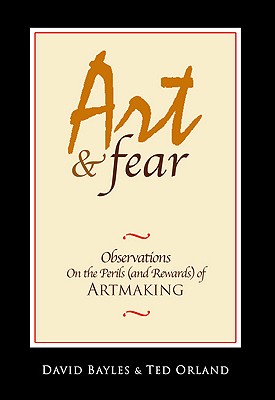
I wrote this response to Art & Fear: Observations on the Perils (and Rewards) of Artmaking by David Bayles and Ted Orland in January 2012 as part of my MFA Writing studies. Reading through it tonight I felt it was worth sharing on the blog. It’s quite autobiographical and contains a few lessons in self-awareness and self-acceptance that anyone in a creative field must work through and overcome.
* * * 


Art & Fear is a fascinating book touching on several points throughout my professional and personal life. It has stirred up many thoughts and emotions, evoking memories of my artistic roots and where I find myself now, questioning my seemingly unorthodox path from aspiring artist to corporate communicator.

I have always been involved in the arts. Before I was ten I had already decided I would be an artist when I grew up. By the time I was in college I already had several years experience in making art: played guitar in rock bands, painted with oils, wrote short stories, wrote and performed at poetry slams, and shot, developed, and printed black and white 35 mm film. These passionate endeavors led to my pursuit of a BFA as a Fine Art major with the predetermined career path to become a professional artist.

The harsh reality hit shortly after graduation. Within a few months it became clear that digital media was replacing the traditional methods at a rapid rate. The local freelance creative job market was intensely competitive. Having found I was adept at using Photoshop I launched my career as a digital photo-retoucher building off my traditional education in painting and photography. Not quite the fine artist pursuit, but it satisfied my creative urges and paid the bills. Digital graphic design soon followed as I continued to expand my capabilities, eventually leading to web design and development.

It was never easy; I found myself stopping some of my much beloved creative disciplines, particularly writing and music, to focus my energies on becoming the best digital artist possible with no formal training in new media. Fortunately, in recent years writing has made a surprising re-entry in my life, now playing a dominant part of my profession.

Early in the book, the authors of Art & Fear explain the grim reality that ninety-eight percent of graduates with art degrees are set up to fail. A lack of preparation and education on the business of artmaking tends to be a problem in the art schools – it certainly was when I was a student. Art is an accepted profession in our country, but not an accepted occupation. As Bayles and Orland vividly point out, “if ninety-eight percent of our medical students were no longer practicing medicine five years after graduation, there would be a Senate investigation.” (11). I know too many such art grads who have failed in their artistic careers soon after college. Talented individuals who did not know how to make a living as artists, who did not know the right people at the right times, who did not know how to apply their talents and skills to a tangential profession outside of their comfort zone. Looking back it seems I was one of the fortunate few.

So here I am fifteen years later, as a web designer, as a business writer, as a professional communicator, I have never once deviated from the creative path I set out on in my teens. But I cannot call myself an artist. I have not primed a hand-stretched canvas or pressed an intaglio print in several years, but the knowledge of color, texture, form, composition, and storytelling is carried with me in the communication work I produce today. Writing a strategy requires a great deal of creative thinking, in both the over-arching concepts and the tactics to implement it. Creating a website is a multidisciplinary task involving skills in writing, design, user experience, and technology. Why should these sorts of works disqualify me from being an artist? I never technically quit; I evolved.

However, Bayles and Orland do write, “For most artists, making good art depends upon making lots of art, and any device that carries the first brushstroke to the next blank canvas has tangible, practical value.” (61) Any device … has tangible, practical value caught my attention, as in the medium and method do not matter as long as the artistic intent is there. Have I been an artist all along?

I have found myself in this gray area throughout my career. When I am asked what I studied in school, my answer is naturally fine art, and I get the funny look. How did I get here from there? Did I throw away my education and sell out? Of course not, I applied everything from my fine arts education to become what I am today, whatever that label might be.

Ultimately, what this book instilled in me was self-acceptance. I understand where I came from is not so unique; many aspiring artists have traveled this path. I am getting over the fear of calling myself an artist, a writer, or any other creative title. As long as I am true to myself, in my corporate communication job, or in my revitalized interest of becoming a professional writer, no one can take that away from me despite his or her level of acceptance or understanding. And I can live with that.

A writer’s maturation of character

Last week I wrote about drawing influence from published writers. Over the weekend, my latest influence revealed itself. Last week through Saturday morning I had been reading Robert Stone’s Fun With Problems, a collection of short stories dealing with heavily flawed characters existing in the darker side of humanity whether or not they even realize it. In some incredible feat, I spent at least ten hours on Saturday writing, rewriting, and revising a short horror story. I don’t get to spend that much time writing in one day usually, it was a strange feeling when I had wrapped it up for the night, like I had stepped out of time and reality. I didn’t want to come back at first, but my family came home, we needed dinner and so on.

The revelation came as I was reading the story aloud. Stone’s book influenced my approach to incorporating my protagonist’s backstories; slowly revealed details layered one on another creating a complex persona in as few words as possible. Without this awareness during the process, I found myself striving for new depths in character creation. Not to say I’ve never dug deep before; this was different.

I found specific intent in what I wrote about his past actions and their effect on the current-day storyline. Writing this horror story has become a psychological study of this heavily flawed character, seemingly laced with lessons in morality, maybe even spirituality. Good versus evil in this story became a thick pool of grayness, a viscous organic byproduct of several visceral systems malfunctioning in tandem. My flawless victim of circumstance born of mediocrity in the rough draft matured into a well rounded, wonderfully dark, and flawed character with the charm of a successful door-to-door vacuum cleaner salesman and the patience of a hungry cat. I leapt over a hurdle I never knew was there.

Perhaps my protagonist, as different as he is from me, is my reflection or a second personality buried in my subconscious. We shall see.

Starting anew

New semester. New MFA writing. I have been away from this blog during the summer, not for any reason in particular, except for moving to a new home and undergoing some minor medical stuff. The fall semester has begun; a good excuse if any to dedicate time to this thing.

I read over the weekend as I recovered from surgery Cormac McCarthy’s The Road, which I will focus on in more detail in a following blog entry. I’m still processing it twenty-four hours later. Deep, dark, heavy, bleak, cold. The commentary on the value of religious belief, human nature, compassion, survival instincts, father-son relationships, trust, and the downfall of human civilization. To dissect McCarthy’s writing style at this moment is a massive undertaking I’m not prepared to take on for this blog, at least not today, but his rule-breaking and the resulting creative freedom is something I can cherish and learn from.

Unusual sentence structures. The lack of quotation marks for dialogue and apostrophes missing from certain conjunctions, like “havent” and “didnt.” The subtle convergence of inner dialogue, dreams, and third person narrative, which occasionally slipped into first person. All to tell the story exactly as McCarthy intended. The first few pages required some adjustment to the odd style, but I fell quickly into his post-apocalyptic world, his style providing foundation and lending to atmosphere rather than creating disruption. His disruptive style became my normal as the reader.

My take away is simple. Style, whether or not rules are intentionally broken, is as much a key part of the story as the characters and plot. Another tool in the writer’s toolbox, to borrow from Stephen King, that creates the indisputable uniqueness of a writer.

The Road has set the stage for an intriguing semester of new writing, new methods, new experiments with style. The perfect kickoff.

A Writers Exploration: Where I Am

I am here in early May as my MFA Writing program spring semesters wraps. I have definitely come out ahead from where I started, making a few self-discoveries along the way. For instance, I learned that I am a natural at writing horror and suspense in my fiction life, something I never touched on until recently. I had always aimed at the slice of life, somewhat absurd, realism in my earlier days of writing, mixed with elements of surrealism for the unexpected. Rejuvenating my writing style in the psycho thriller and horror area story feels like a natural progression for me, one that I just took the risk and succeeded at. Who knew? My first story in this genre will be published soon, details to come.

I find myself filled with far more knowledge about the discipline of corporate communication and PR than I had ever anticipated. The things that come out of my mouth on this subject at work or during casual conversations catch me by surprise sometimes, only proving that my MFA endeavor is anything but futile. I now have a solidified foundation in communication that I have already begun to build upon, which will only continue upwards as I finish my schooling and grow in my professional life.

Most important, I find myself a more confident writer, no longer afraid to take risks and voice my opinions. Risk-taking led to my upcoming first horror publication and brought out my contrarian nature in the world of critiques and classrooms.

Recently, my classmates learned that I couldn’t assimilate with the accepted norm; rather, I innately challenged the authenticity and validity of a big Hollywood screen adaptation to a great Stephen King novella, Rita Hayworth and the Shawshank Redemption. Surprisingly, most of my classmates respected my opinion and did not appear as upset as I had expected considering the Shawshank Redemption film is so highly revered. I did write my review with the utmost respect, after scrapping the scathing first draft. What can I say? I’m an obsessive purist in my artistic roots, it’s who I am. The movie on its own was good, but did not capture the complexity and the many shades of gray that is human nature as depicted in the book. But that’s a whole other discussion.

So, here I am writing my last blog entry for the spring 2012 semester. It’s sad to see a great semester come to an end, but exciting to know I have accomplished so much and gained some new friends along the way. I am already eagerly anticipating the next semester and reconvening with my classmates at our next residency in August.

As for this blog, I will carry on regularly.

A Writers Exploration: The Rules are the Rules are for Breaking

The concept of rules in writing has circulated in my head this past semester, some thoughts seeing the light of day on a previous blog post. My obsessive nature makes me want to be a purist, following all regulations on grammar and sentence structure to the extreme. But the proverbial devil on my left shoulder, who’s persuasion over me has been quite successful in recent months, has helped me deviate quite effectively. Taking risks in my writing has become my normal, sometimes it works well, leading a short on its way to publishing soon, and other times it falls flat on the iced-over concrete resulting in a few bruised ribs and a shattered ego. But that’s okay; “live and learn,” as someone once said before it was repeated a billion times.

I recently read a few stories written outside of the mainstream when it comes to point-of-view and tense that jarred my attention. These stories felt odd, foreign beyond earthly limits, stimulating my imagination as I prepare to work on my current pieces.

The first story was written in second person in the present tense. Yes, you read that correctly. How often do you find yourself reading about yourself placed in a life that you never lived? Fiction is traditionally written in either first or third person, generally dependent on the author’s preference and intent, but second is a whole other world. Check out the following published story, “Sacrifice,” written by Jenn Powers, a peer in my MFA program. Whether or not it was intended, the story plays off the double portrait concept, in which the author paints a portrait of another person who is connected by some type of relationship and thereby creates a self-portrait through responses and interactions. I highly recommend reading the brilliant essayist Philip Lopate to learn more on this subject. Moving back to the story, the reader assumes the role of the protagonist’s ailing and embittered grandmother, grieving the loss of her long-time husband. It is a tragic story conveying a lot of emotion. As I read, I learned about the protagonist’s strong bond with her grandmother and the endearing sadness caused by the current situation. I got to know the protagonist as a result.

A second story that transported me into in another part of the animal kingdom was Tim Weed’s “Snarl.” Tim is a writing mentor in the Western Connecticut State University Writing MFA program. It’s written in the first-person present tense with an additional twist – from the perspective of a hyena. The story moves in real time as it is read, time lapses represented by extra line breaks. Humans are seen as strange and foreign creatures called “skin-monkeys” with their “fire machines” and “false suns.” Essentially, Tim has created a sci-fi story resembling the enslavement of humans by an alien race; only the humans are the aliens here. I fell into this story in the first few paragraphs; the vivid sensory elements placed me in the head of a hyena with his mate on the run from a fenced-in enclosure, presumably a zoo – a sort of Bonnie and Clyde scenario only ore visceral than bank robberies.

The rules exist to provide structure and guidance as we develop ourselves as creative beings regardless of our chosen discipline. Traditional methods, such as writing in past tense and third person exist to provide stability and a level of comfort while exploring the craft. When you have mastered the craft, you must master undoing all of those rules and traditions to find your voice, to let your nature shine through your art. In other words, break the rules when you know how to do it well and with intent. Show no fear.